Tool

Loading tool...

Preparing workspace.

What this tool does

Check Server Status is built for a practical workflow.

HighSEOTools pages explain the signal, the limits, and the next sensible check before a user relies on the output.

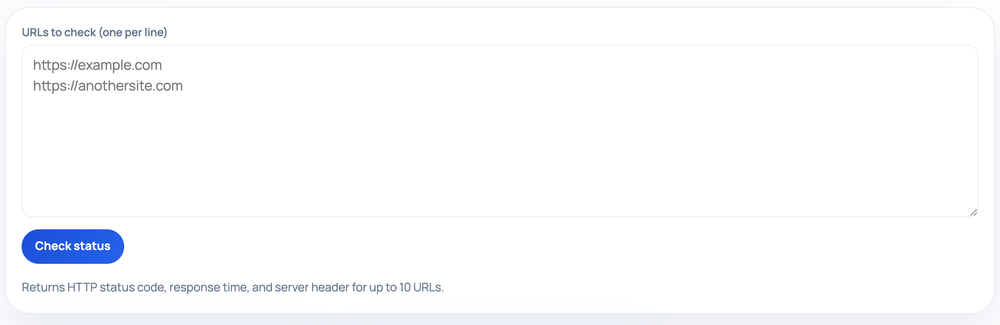
Check Server Status helps visitors handle availability, redirect, crawler, and indexability checks with public URLs, domains, redirects, or live page responses. Check live availability, DNS resolution, HTTP headers, and basic server response health for a public URL.

Check Server Status is part of the live HighSEOTools catalog and is intended for real visitor use. The page explains what to prepare, how to use the result, and what to check next instead of leaving visitors with a thin form and no guidance.

The tool sends only the public URL or domain needed for the check to the application endpoint. This matters because a useful SEO or utility page should explain the signal, its limits, and the next action.

Who should use it

  • Marketers can use Check Server Status when a campaign page needs status details, crawl clues, and technical follow-up tasks before traffic is sent to it.
  • Bloggers and publishers can use Check Server Status while refreshing older posts, checking drafts, or preparing supporting assets.
  • Developers can use Check Server Status during release QA when public URLs, domains, redirects, or live page responses needs a quick visible check.
  • Students can use Check Server Status to understand availability, redirect, crawler, and indexability checks with concrete inputs instead of vague definitions.
  • Small businesses can use Check Server Status as a no-signup utility when they need a practical answer without buying a full suite.

Step-by-step usage

  1. Open Check Server Status and start with one representative input.
  2. Enter public URLs, domains, redirects, or live page responses exactly as it appears in the current workflow.
  3. Run the tool and review the primary output: status details, crawl clues, and technical follow-up tasks.
  4. Read warnings and helper text before copying the result elsewhere.
  5. Compare the result with the examples and common mistakes on this page.
  6. Use the related tools to continue the workflow; the next useful step is to document the issue and retest after DNS, hosting, or page changes settle.
  7. Retest after editing the page, file, copy, or domain.
Practical examples

Examples for Check Server Status.

Examples make the page useful before and after the tool output is generated.

Publishing QA with Check Server Status

Before: A publisher is about to release a page but only has a rough sense that the availability, redirect, crawler, and indexability checks work is complete.

After: After using Check Server Status, the publisher has status details, crawl clues, and technical follow-up tasks and a clearer list of fixes to handle before the page is submitted or promoted.

Small business website refresh

Before: A local business updates a service page and wants to avoid publishing weak or technically unclear work.

After: Check Server Status helps the owner review the relevant input, document the result, and decide whether a technical SEO, metadata, or content check should follow.

Developer handoff

Before: A developer receives public URLs, domains, redirects, or live page responses from a marketer or editor and needs a quick way to verify it before implementation.

After: The developer uses Check Server Status to produce status details, crawl clues, and technical follow-up tasks, then keeps the result with deployment notes or the content ticket.

Benefits

Why this tool is useful

  • Check Server Status gives users a focused starting point for availability, redirect, crawler, and indexability checks instead of forcing them through an unrelated dashboard.
  • The page explains the limits of the result, reducing the risk of treating status details, crawl clues, and technical follow-up tasks as more precise than it is.
  • Related links help users continue into a technical audit, metadata review, keyword check, or content cleanup step.
  • The free, no-signup approach makes Check Server Status practical for one-off checks by students, bloggers, small businesses, and developers.
  • Examples and FAQs give the page useful context even before a visitor runs the form.
Common mistakes

What to avoid

  • Using Check Server Status on an old draft or stale URL and assuming the result describes the current published page.
  • Treating one metric or conversion result as a final decision without reviewing the page, file, or domain manually.
  • Ignoring the input format. Check Server Status works best when the starting point is clean public URLs, domains, redirects, or live page responses.
  • Copying output directly into production without checking whether it matches the page's real purpose and audience.
  • Skipping the recommended next step: document the issue and retest after DNS, hosting, or page changes settle.
FAQ

Questions about Check Server Status.

These notes keep the workflow useful and honest about scope.

What does Check Server Status do?

Check Server Status helps users handle availability, redirect, crawler, and indexability checks by working with public URLs, domains, redirects, or live page responses and turning it into status details, crawl clues, and technical follow-up tasks.

Who should use Check Server Status?

Check Server Status is useful for marketers, bloggers, developers, students, and small businesses that need a focused free tool.

Is Check Server Status free?

Yes. Check Server Status is published as a free HighSEOTools page with no account requirement for the basic workflow.

Does Check Server Status guarantee rankings?

No. The result is a practical QA signal, not a ranking guarantee or replacement for human review.

What should I check after Check Server Status?

The best next step is to document the issue and retest after DNS, hosting, or page changes settle. Related links on the page help continue that workflow.

Related section

Continue with Website Tracking Tools.

Availability checks, index tracking, redirects, and browser diagnostics.