Text Analysis Tools

Readability Checker

Paste text and the checker computes Flesch Reading Ease and Flesch–Kincaid Grade Level, plus average sentence length, syllable counts, the share of complex words, and an estimated reading time — with a plain-English label for the score.

Text Analysis ToolsBrowser ready/readability-checker

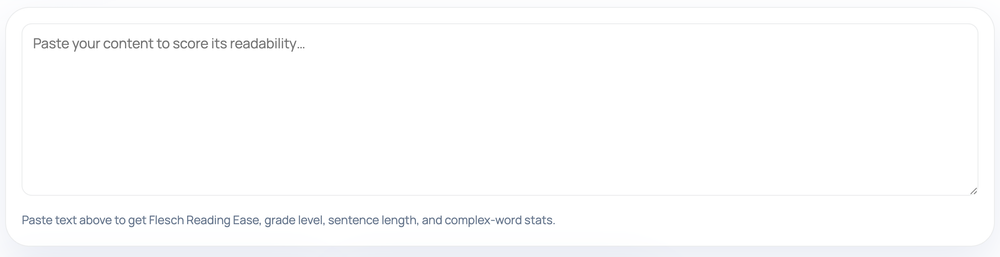
Paste text written with basic-Latin letters to get heuristic Flesch Reading Ease, grade level, sentence length, and complex-word stats.

Step by step

How to use the Readability Checker

  1. Paste text written with basic-Latin letters into the box to score it automatically.
  2. Read the Flesch Reading Ease score and Flesch-Kincaid grade level, if the input is eligible for the English heuristic.
  3. Review words-per-sentence and the percentage of complex (3+ syllable) words.
  4. Check word, sentence, syllable counts and reading time below.
How to use the Readability Checker — tool screenshot
The Readability Checker on HighSEOTools

Pro tip: Compare drafts for the same intended readers. The English syllable heuristic is a revision aid, not a universal target or an assessment of writing quality.

What the scores measure

Readability formulas estimate a passage from two surface signals: sentence length and syllables per word. This tool clamps Flesch Reading Ease to 0–100, where a higher result means the formula saw shorter sentences or fewer syllables per word. Flesch–Kincaid Grade Level converts the same counts into a US-school-grade-style number. Neither result measures accuracy, organization, tone, or whether the writing suits your readers.

Alongside the numbers, the tool shows a plain-language label such as "Standard (8th–9th grade)" or "Difficult (college)". Those bands are this tool's interpretation of the formula, not an educational assessment or a universal writing target.
The formulas, stated plainly

Reading Ease is 206.835 minus 1.015 times average words per sentence minus 84.6 times average syllables per word. Grade Level is 0.39 times average words per sentence plus 11.8 times average syllables per word minus 15.59. The tool accepts word tokens made from basic-Latin letters and scores them with an English spelling and vowel-group syllable heuristic. It cannot determine whether a basic-Latin word is actually English; alphabetic words outside basic Latin leave the score unavailable. It splits sentences on . ! and ?, counts only segments containing a word, and estimates syllables with silent-e and -ed adjustments. Different token, sentence, and syllable rules explain why calculators can differ.

The full set of metrics

  • Flesch Reading Ease and Flesch–Kincaid Grade Level, the two headline scores.
  • Average words per sentence, the lever that most affects both scores.
  • Total words, sentences, and syllables counted from your text.
  • The percentage of complex words — those with three or more syllables — as a quick proxy for vocabulary load.
  • Estimated reading time, based on a typical silent reading pace of about 200 words per minute.

Using it to improve a draft

Treat the checker as a revision aid, not a grading machine. When comparing versions for the same readers, the words-per-sentence figure can reveal a run-on sentence and the complex-word percentage can point to vocabulary worth reviewing. Keep a precise term when it is needed; changing text only to move a formula can make it less clear.

Choose clarity criteria from the audience and task, then use the scores as one structural signal. A specialist document and a general explanation can need different vocabulary and sentence structure.

Common mistakes

  • Chasing a higher score by chopping sentences so short the writing turns choppy and loses flow.
  • Replacing a precise technical term with a vaguer everyday word just to drop a syllable, sacrificing accuracy.
  • Applying a general-audience target to specialist content that legitimately needs denser vocabulary.
  • Reading small differences from another tool as errors — they usually come from syllable-counting heuristics.
  • Pasting text full of abbreviations or list fragments, which can throw off sentence detection.

Honest limits and privacy

These formulas count structure, not meaning. A passage of plausible-sounding nonsense can score as easy, and rephrasing a clear sentence just to nudge the grade down can hurt clarity. They also do not judge organization, accuracy, or tone — a well-scored page can still be poorly argued. Use the numbers as a sanity check that flags long sentences and dense vocabulary, not as a target to game. The score is calculated in the browser without this widget making a server request for your text; assess sensitive material against your own browser and device environment before pasting it.

Worked examples

See it on real input

A short, plain passage

Input: The cat sat on the mat. It was a warm day.

Output: Measured 2026-09-11 with the current browser implementation: 11 words; 2 sentences; 11 syllables; Reading Ease 100; Grade Level 0.0; 0% complex words; 1 minute.

Paste this exact text to reproduce the fixture with the current English heuristic.

A dense academic sentence

Input: The implementation necessitates comprehensive evaluation of multifaceted organizational dependencies.

Output: Measured 2026-09-11 with the current browser implementation: 9 words; 1 sentence; 33 syllables; Reading Ease 0; Grade Level 31.2; 78% complex words; 1 minute.

Paste this exact text to reproduce the fixture with the current English heuristic.

FAQ

Readability Checker — what people ask

What Flesch Reading Ease score should I aim for?

There is no universal target. Set clarity expectations from the audience and task, then use this tool to compare structural changes in drafts for those same readers. Its label is an interpretation of the formula, not a requirement.

Why does another tool report a slightly different score?

Because syllable counting and sentence detection use heuristics, and small differences in how abbreviations or hyphenated words are handled shift the totals. Expect minor variation between calculators.

How is a complex word defined here?

As a word of three or more syllables. The percentage of such words is a quick proxy for vocabulary load, though some long words are still familiar and easy.

How is reading time estimated?

From the word count and a typical silent reading speed of about 200 words per minute. It is an average, so a careful or skimming reader will land above or below the figure.

What is the difference between Reading Ease and grade level?

They are two scales over the same counts. Reading Ease is a 0–100 number where higher is easier; grade level maps to a US school year. Use whichever is easier for your team to act on.

Is my text sent to a server?

The widget calculates the score in the browser and does not make a server request for the text you paste. Assess sensitive material against your browser, extensions, and device environment before using any web page.

Site standards

How HighSEOTools handles data and methodology

I document how each check works, where its data comes from, and which parts are only estimates.